The Oskár Čepan Award
Archive
13. 10. 2026
30th anniversary of Oskár Čepan Award at TU-BA
13. 10. 2026
Profile - Andrej Kiripolsky
→ Tlačová správa COČ 2026 Andrej Kiripolsky
13. 10. 2026
→ Tlačová správa COČ 2026 Natália Šimonová
13. 10. 2026
→ Tlačová správa COČ 2026 Norbert Kuki
29. 4. 2026
29. 4. 2026
29. 4. 2026
28. 4. 2026
Laureates of Oskár Čepan Award 2026
23. 4. 2026
23. 4. 2026
23. 4. 2026
23. 4. 2026
3. 3. 2026
"In my practice, I focus on how the infrastructures of the industrial era persist even after losing their original function, and continue to shape landscape, bodies, and social relations. I am particularly interested in the condition in which industry has not fully disappeared, yet no longer serves its original purpose. It is precisely within this space between operation and decline that infrastructure reveals itself not merely as a technical system, but as a carrier of memory, labour, burden, and collective experience.
This approach grows out of personal experience. I grew up in the Upper Nitra region, where extraction and energy production have long determined both the character of the landscape and the rhythms of everyday life, and I later worked in the maintenance department of the Nováky power plant during its final period. This experience allowed me to understand industry not as an image of the past, but as a living structure composed of routine, repair, waiting, wear, and gradual disappearance. In my work, industrial heritage therefore does not appear as a nostalgic relic, but as an unresolved process in which technology, social reality, and environmental consequences remain entangled.
I work with materials and objects sourced directly from industrial sites, such as ash, steel pipes, welding curtains, and work-related or administrative elements connected to maintenance. I am not interested in them as readymades in a narrow sense, but as materials that carry a specific history of labour, circulation, and decline. When relocated into the gallery, their function changes, but not entirely their weight. In this new context, they become a means of thinking through what remains after industry, and what new meanings these residues may acquire.
Sound is an important part of my practice, and I do not treat it as a supplementary element, but as a way of making infrastructure present on a bodily level. In my installations, sound often emerges directly from the material itself through dripping, friction, vibration, or pressure, so that the viewer encounters industrial space not only visually, but also through rhythm, resonance, and delay. In works such as Have You Ever Seen Coal Burn?, Courtesy to Intervene, or Work Chronicles, I try to make present not only the material remains of industry, but also the invisible labour of maintenance, the tension between function and breakdown, and the ambivalent legacy of environments shaped by pride, dependency, exhaustion, and loss."
Andrej Kiripolsky (2000, Bystričany) graduated from the Royal Danish Academy of Fine Arts in Copenhagen and the Film and TV School of the Academy of Performing Arts in Prague. Projects (selected): 2025 Have You Ever Seen Coal Burn?, Kunsthal Charlottenborg, Copenhagen, 2024 They may rest from their labor; for their deeds follow them!, Q Gallery, Copenhagen, 2024 Country roads, take me home, SVĚTOVA 1, Prague. He is the recipient of the 15 June Foundation’s Honorary Prize 2025 and a current resident at Art Hub Copenhagen.
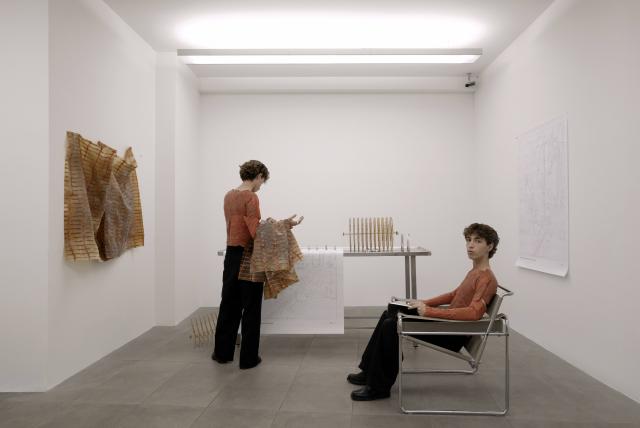
The photo shoot, creatively directed by Evelyn Bencicová, features portraits of the curator and the laureates from less traditional angles, which nevertheless reveal more of the behind-the-scenes aspects of their artistic practice, as well as their self-expression through specific gestures and attributes.