The Oskár Čepan Award
Archive
13. 10. 2026
30th anniversary of Oskár Čepan Award at TU-BA
13. 10. 2026
→ Tlačová správa COČ 2026 Andrej Kiripolsky
13. 10. 2026
Profile - Natália Šimonová
→ Tlačová správa COČ 2026 Natália Šimonová
13. 10. 2026
→ Tlačová správa COČ 2026 Norbert Kuki
29. 4. 2026
29. 4. 2026
29. 4. 2026
28. 4. 2026
Laureates of Oskár Čepan Award 2026
23. 4. 2026
23. 4. 2026
23. 4. 2026
23. 4. 2026
3. 3. 2026
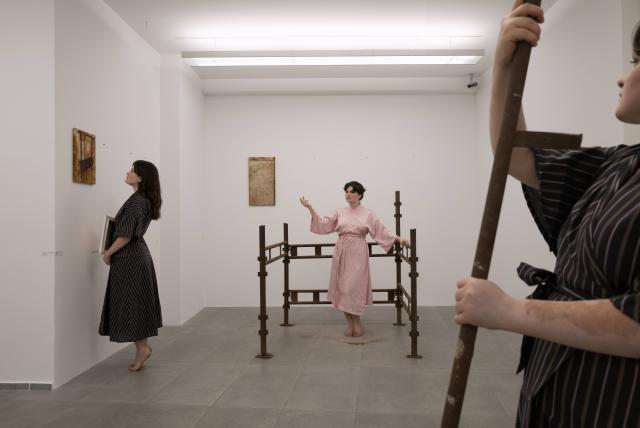
My artistic practice is conceived as a long-term, systematic research of elements within public space, with a particular focus on post-socialist structures in Slovakia.This research is grounded in the analysis of layers—material,visual,and social. Initially,my work focused on children’s playgrounds from the socialist period,examined through the lens of destruction;over time, however,I have expanded this framework to encompass a broader field of public space and its typological elements.My practice is based on a dynamic relationship between image and reality.I translate layers of public space into the medium of painting,where they are transformed into pictorial structures,while at the same time allowing painterly layers to re-enter physical space as autonomous interventions.I thus understand painting within the framework of the expanded field—not as a closed pictorial object, but as a processual entity capable of exceeding its own medium and participating in the formation of both material and semantic layers of the environment.Rust constitutes the primary medium of my work, which I perceive both as a material and as an index of time.Its processual character—growth,decay,and transformation—parallels both natural and socially conditioned changes.In my paintings,rust and corrosion operate as active processes:they grow,falldown,and shift in tonality.Corrosion,understood as the degradation of materials(particularly metals),has become a subject of deeper investigation within my practice.Through this research,I have engaged with scientific approaches to corrosion,including the work of Prof.J.Kocich,often referred to as the“father of rust”in Slovakia,whose publications(such as Corrosion and Protection of Metals)have significantly influenced my understanding of material processes. Within this context,I approach painting through the principle of “deep mimesis”—a form of intrinsic resemblance to the phenomena under examination, in which the image does not function as representation, but as a materially and conceptually analogous structure.Alongside rust,I employ techniques such as frottage,collage, décollage,and oil painting,all of which I subject to processes of destruction.In my recent work, drawing and color have assumed a more prominent role,with expressive painterly gestures entering into tension with processes of erosion and decay.This tension between construction and destruction constitutes one of the fundamental principles of my practice.I understand material degradation,layering,and the uncovering of surfaces as visual analogies to shifts in social regimes,collective memory,and cultural values.I am particularly interested in moments when objects lose their original function and acquire new,often ambiguous identities.I focus on elements of minor architecture and urban infrastructure—fences,lighting,benches and public announcement systems.I do not approach these objects ideologically,but rather as carriers of everyday experience and sedimented historical layers.I construct my own typological archive of these elements, which enables me to analyze the relationship between the individual and their environment,as well as the mechanisms through which visual experience is formed. Methodologically,my work is grounded in careful observation and analytical engagement with the environment.I seek to reveal subtle,often overlooked relationships and structures situated at the intersection of functionality,aesthetics, and decay.The loss of collective memory,through the deconstruction and disappearance of architectural elements,represents one of my work.